Gourav
 Let’s be honest: the daily grind of a real estate agent is exhausting. Between staging homes, coordinating schedules with expensive videographers, and doing endless takes just to get the perfect property walkthrough, creating high-quality video content can quickly drain both your time and your marketing budget.
But what if you could guide potential buyers through a property 24/7 without ever having to drive across town or step in front of a camera?
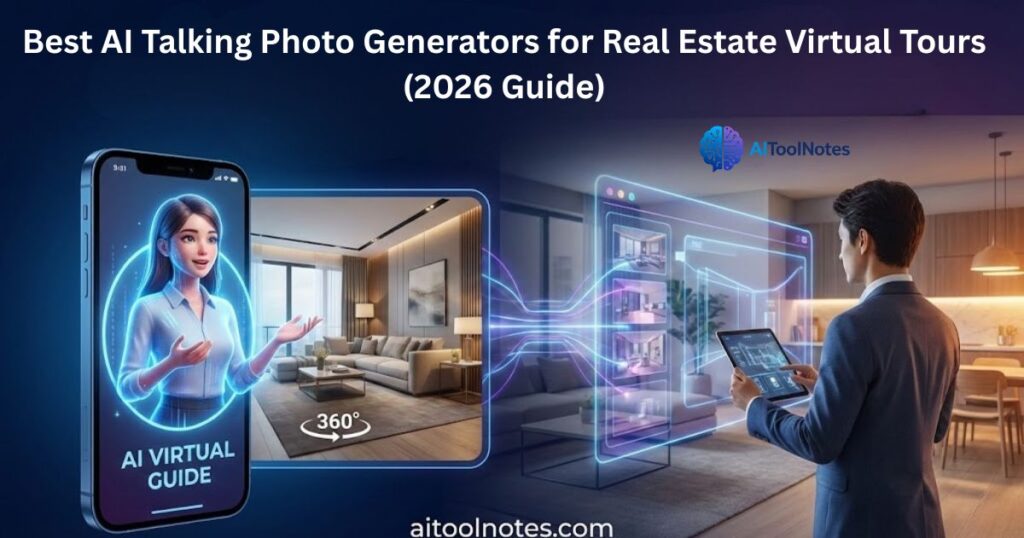
Enter AI talking photo generators. These tools are completely changing the game for real estate marketing. With nothing more than a single professional headshot and a typed script, you can now generate a lifelike, speaking virtual concierge that guides clients through a virtual tour, completely hands-free.
If you want to scale your property listings and cut down on production costs, you are in the right place. In this guide, I’ve broken down the top AI talking photo tools on the market right now, evaluating them on the things that actually matter to your business: lip-sync accuracy, ease of use, and out-of-the-box realism. Let’s dive in.
Top AI Talking Photo Generators at a Glance
I’ve spent the last few weeks diving deep into these platforms so you don’t have to waste your time—or your marketing budget. When you’re trying to sell a home, you don’t need a clunky, robotic avatar scaring away potential buyers. You need realism, speed, and software that actually makes your life easier.
Here is my honest breakdown of the heavy hitters dominating the real estate space right now:
| AI Tool | Best For | Standout Real Estate Feature |
| HeyGen | Premium Agent Cloning | Flawless avatar realism and natural hand gestures. |
| D-ID | Quick Portrait Animation | Highly stable facial identity from a single still photo. |
| DupDub | Multilingual Tours | 90+ native accents to reach international buyers. |
| Synthesys | Fast Turnarounds | Massive library of 370 voices across 140 languages. |
Why These Tools Made the Cut (The Real-World Value)?
To give you a better idea of which software actually fits your day-to-day workflow, here is how they perform in the trenches:
- HeyGen (The undisputed king of realism): If you are selling high-end luxury properties, this is your tool. Their latest updates include incredibly natural micro-expressions (like subtle blinks and head tilts). You can clone yourself once and have your digital twin give 100 flawless property tours without you ever having to do your hair, makeup, or drive across town.
- D-ID (The speedy workhorse): I love D-ID for its sheer simplicity. If you just got a new listing and need a quick market update video for Instagram within five minutes, D-ID is unbeatable. You can take a standard, professional headshot from your website and animate it almost instantly to deliver the news.
- DupDub (The international deal-closer): Real estate is increasingly global. What surprised me about DupDub is its massive focus on localization and its user-friendly mobile app. If you have an out-of-state or overseas buyer looking at a property, you can generate a tour in their native language with an authentic regional accent. It instantly builds trust.
- Synthesys (The corporate scaler): If you run a larger brokerage and need to pump out standardized virtual tours or training videos at a high volume, this platform handles scale beautifully. Their massive voice library means you can find the exact tone—whether authoritative or welcoming—that matches your specific property listing.
Deep Dive: My Hands-On Test of the Best AI Talking Photo Tools in 2026
I didn’t just read the landing pages for these platforms—I actually created accounts, uploaded my own headshots, and ran test scripts to see how they handle real-world real estate workflows. If you are going to trust a piece of software to represent your face and brand to potential home buyers, you need to know exactly how it performs under pressure.
Here is my ultimate testing matrix based on generating standard 60-second property intro videos:
| AI Platform | Overall Usability | Lip-Sync & Realism Score | Avg. Render Time (60s clip) | Best Real Estate Use Case | My Honest Verdict |
| HeyGen | 9.5 / 10 | 9.8 / 10 (Flawless) | ~4 Minutes | Luxury & High-End Listings | The undisputed king of realism. Worth the premium price tag. |
| D-ID | 8.5 / 10 | 8.2 / 10 (Great) | Under 60 Seconds | Quick Social Media Updates | The fastest workflow. Perfect for daily Instagram or Zillow updates. |
| DupDub | 8.0 / 10 | 8.0 / 10 (Solid) | ~2.5 Minutes | Multilingual / Foreign Buyers | Best native accents. An absolute steal if you sell internationally. |
| Synthesys | 8.5 / 10 | 8.5 / 10 (Great) | ~3 Minutes | Brokerage-Wide Scaling | Massive voice library. Best if you need lots of different agent tones. |
The Full Breakdown: Which Tool Should You Actually Buy?
Data only tells half the story. Here is what I noticed when I actually put these tools to work, and why you might choose one over the other for your specific brokerage:
- HeyGen (The Premium Choice for Luxury): In my tests, HeyGen completely blew the competition away when it came to out-of-the-box realism. I uploaded a standard headshot, and the rendering engine automatically added subtle micro-expressions—like natural eye contact, slight head tilts, and perfectly timed blinks. If you are selling a $2 million property and want a “digital twin” to guide the luxury virtual tour while you stay at your desk, this is the only tool I’d trust. The rendering takes a bit longer, but the hyper-realistic result is incredible.
- D-ID (The Speedy Workhorse for Social Media): If HeyGen is a high-end cinematic camera, D-ID is your trusty smartphone. What I love about D-ID is the sheer, raw speed. When I tested a quick script announcing a price drop, I had a fully animated, ready-to-post video in under a minute. The interface is incredibly simple. If you are an agent who pumps out weekly market updates on Facebook or needs a fast intro for a new Zillow listing before heading out the door, D-ID will save you hours every week.
- DupDub & Synthesys (The Global Reach Giants): Real estate is a global game now, and these two tools completely change how you can market a property. When I tested DupDub, I ran a property description script through their translation engine. The AI didn’t just change the words; it mapped my photo to speak with a flawless, native-sounding Spanish accent. Synthesys offers a massive library of 370 voices, which is brilliant if you are running a larger agency and want to match the “vibe” of the voice to the property (e.g., a warm, cozy voice for a family home vs. a sleek, authoritative voice for a commercial space). Both tools instantly expand your buyer pool without you needing to hire a translator.
Why Real Estate Agents Are Switching to AI Avatars in 2026?
Let’s be real for a second: the traditional way of marketing a property is slow, expensive, and incredibly repetitive. I talk to top-producing agents all the time, and their biggest bottleneck isn’t finding buyers—it’s creating enough high-quality video content to stay relevant without burning out.
If you are wondering why so many agents are suddenly using AI digital twins for their listings this year, it essentially comes down to a massive shift in how we handle our daily workflows. I put together this comparison to show exactly why the old way of shooting listing videos is quickly becoming obsolete:
| The Bottleneck | The Old Way (Traditional Video Crews) | The AI Avatar Advantage | The Real-World Impact on Your Business |
| Speed to Market | Waiting 3 to 5 business days for a videographer to shoot, edit, and deliver the final property walkthrough. | Snapping basic photos, pasting a script, and generating a fully narrated virtual tour in under 15 minutes. | You get the listing live on Zillow and social media while it’s still piping hot, preventing stale days on the market. |
| Brand Consistency | Relying on your daily energy levels. You have to be perfectly styled, rested, and “on” for the camera. | Your digital twin doesn’t get tired. It is 100% polished, confident, and energetic on every single take. | You maintain a hyper-professional personal brand on every listing, even if you are eating lunch in your car between showings. |
| Cost Efficiency | Paying $250 to over $1,000 per listing for professional shooting, editing, and drone footage. | Paying a flat $30 to $90 per month for unlimited video generation and 24/7 access to your AI clone. | You stop giving away massive chunks of your commission just to get basic marketing collateral out the door. |
Strategic Marketing Tip: Don’t just use these avatars for property walkthroughs! The agents seeing the highest return are using their AI clones to automatically send personalized “Welcome to the Neighborhood” or “Market Update” video emails to cold leads. It humanizes your outreach and drastically increases your response rate compared to a boring text email.
Step-by-Step: How to Create Your First AI-Guided Tour
I remember when creating a virtual tour meant buying a $3,000 camera rig and spending three days trying to stitch the files together on a crashing computer. It was a nightmare.
Thankfully, the landscape has completely shifted in 2026. You don’t need to be a video editor or a tech wizard to build an immersive, AI-guided walkthrough. If you can use a smartphone and drag-and-drop files, you can have your first digital concierge up and running by this afternoon.
Here is my exact, foolproof blueprint for putting it all together in under an hour:
| Step | The Action | The 2026 “Fast Track” Method | Estimated Time |
| 1. Capture the Property | Shoot standard 360-degree photos or a basic video walkthrough of the home. | Grab an affordable 360 camera (like the Insta360 X4) or just use your smartphone with an app like CloudPano or Kuula to capture the rooms. | 15 – 20 Minutes |
| 2. Upload Your Headshot | Choose your AI talking photo tool and upload a clear, front-facing professional headshot. | Log into HeyGen or D-ID. Make sure you use a high-resolution photo with good lighting and a clean, uncluttered background. | 2 Minutes |
| 3. Generate the Script | Draft a script highlighting the home’s best features, focusing on the lifestyle. | Don’t write this from scratch! Drop your basic property details into ChatGPT or Claude and ask it to write a “warm, conversational 60-second real estate tour script.” | 5 Minutes |
| 4. Render and Combine | Let the AI animate your photo and overlay the talking avatar onto your property footage. | Generate your AI video with a transparent background (green screen feature). Drop both the property tour and the avatar into a free editor like CapCut, and place your AI clone in the corner of the screen. | 10 Minutes |
My Top Tips for a Flawless AI Tour:
- Keep the Script Punchy: Don’t list every single bedroom dimension—buyers can read the listing for that. Have your AI avatar focus on the feeling of the home (e.g., “Imagine hosting summer dinners around this massive open-plan kitchen island…”).
- Eye Contact is Everything: When taking the initial headshot that you will upload to the AI software, look directly into the camera lens, not at the screen. This ensures your digital twin makes direct, trustworthy eye contact with the buyer.
- Match the Energy: If you are selling a vibrant downtown loft, tell your AI voice generator to use an upbeat, energetic tone. If it is a quiet suburban estate, opt for a warmer, more relaxed cadence.
- Test the Mobile View: Over 70% of buyers will view your tour on their phones. Before publishing, always check your final video to make sure your AI avatar in the corner isn’t blocking important property features on a small vertical screen.
Final Thoughts on the Future of Real Estate AI
I test a lot of software for this blog, and if there is one thing I’ve learned watching the market shift into 2026, it is this: AI is not going to steal your real estate job. A piece of software cannot read the emotional temperature of a room during a tense negotiation, nor can it build the deep, localized trust required to convince a family to make the biggest financial purchase of their lives. The final “yes” will always rely on a human connection.
However, an AI will replace the agent who refuses to adapt.
The final verdict is clear. Tools like HeyGen and D-ID are the ultimate leverage for scaling your marketing efforts. They handle the exhausting, repetitive heavy lifting—the endless video takes, the lighting setups, and the multi-lingual translations—so you can spend your actual working hours doing what you do best: shaking hands, building relationships, and closing deals. It is about using technology to buy back your time.
Now, I want to hear from you: Are you ready to deploy an AI clone for your next property listing to save time, or do you still prefer the traditional authenticity of being on camera yourself? Drop a comment below and let me know your strategy!